what metabolic occured in the test tuves to produce this gas?
Inspiration can come from many places. Sometimes, inventors are inspired by new discoveries in science, and sometimes it's the other manner around – scientists are inspired past new developments in manufacture. This is what happened in the early 20th century after the moving assembly line came of age.
Kickoff introduced by Henry Ford in 1907, the assembly line was not just a single stream of auto parts flowing from one worker to the next. Instead, it was a multi-path system of many assembly groups. Of course, there was a main assembly line that began with the wheels and the bottom of each auto and ended with the completed vehicle, only there were likewise additional tributary lines feeding into the principal line at unlike points. These tributary lines developed components that needed to be pre-assembled individually before they could go into each car. There was a special line for the engine, for the car body, the seats and doors, and movement of parts through each was timed and so as to provide the components to the main assembly line in a coordinated fashion (Figure 1).
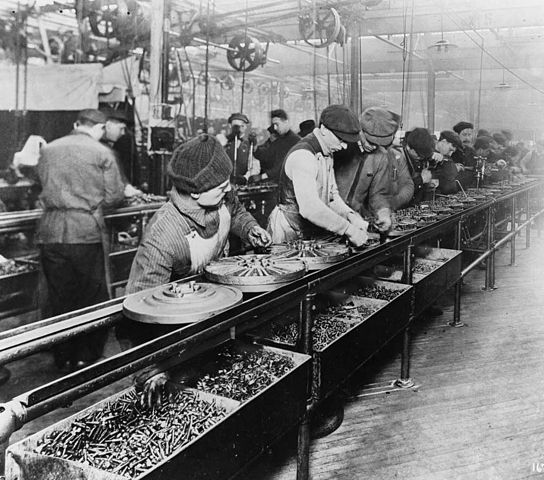
If anything slowed downwards one grouping – a shortage of parts, for instance – the unabridged system would dull. In such cases, the completed components from the other groups would accumulate, since they could not be put into new cars on the main line. Only when all sections operated on schedule, the new Model T cars took shape very apace. In fact, operating similar this, Ford could produce thousands of cars per day, which was a hitting advance over earlier, custom made cars that were hugely expensive and available merely to the wealthy. Other industries chop-chop adopted the assembly line approach.
Past the start of the 20th century, scientists in various fields were already realizing that nature works in cycles. Geologists knew that water must cycle through the ground, oceans, and clouds; astronomers were figuring out that giant clouds of gas were giving birth to stars one by one; and chemists and biologists were starting to think in this fashion also. But with scientists now seeing how efficiently the associates lines could produce cars and other big machines of the era, that cycling aspect of nature now moved to center phase. Might the assembly of stars from gas, clouds from water, or rocks from lava work like a kind of natural assembly line? Moreover, at the microscopic level within cells, might the processing of molecules also go on in an organized way, as if moving through a tiny factory?
In the 1920s and 1930s, biochemists began discovering enzymes – proteins in our cells that catalyze chemical reactions. Simple reactions were worked out rather quickly, only more complicated chemic reactions were difficult to study. For example, if a person consumed compound A in the diet and then excreted compound E in the urine, how exactly did that happen? Was compound A transformed into Eastward directly? Or, did the process occur in steps, similar on an assembly line, with compounds B, C, and D, created forth the way as intermediaries? Were at that place tributary lines generating various components that were needed at unlike points?
Breaking down fuel for cellular energy
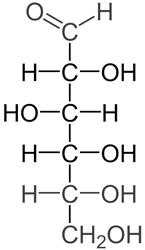
In many cases, the assembly line idea seemed to be the only one that fabricated sense conceptually. Consider glucose, for instance, usually known every bit blood carbohydrate. (See the structure of a glucose molecule in Figure 2.) By the plow of the twentythursday century, scientists knew that glucose was 1 of the main fuels, or sources of energy, for animals, leaner, and yeast. Setting glucose on fire in the laboratory produced carbon dioxide (CO2) and h2o (H2O), the same compounds that animals produced when they exercised. Notwithstanding, no one believed that cells could take tiny fires inside. Observations under the microscope certainly did not prove whatsoever flames. Nevertheless, people do experience a called-for sensation in their muscles during heavy exercise.
Realizing that that the breakdown of body fuels probably took place in a controlled series of steps, researchers imagined enzymes working like manufacturing plant workers, modifying dissimilar parts of a particular chemic chemical compound. Similar the workers on an assembly line, each enzyme would brand one special alter to each molecule. The altered molecule would then be farther modified, step by step by unlike enzymes, and this could happen not only during the breakup of fuels; it also could happen during the production, or synthesis, of needed biological molecules using simpler chemicals as building cloth.
Glucose and other sugars vest to the form of macromolecules called carbohydrates (run into our Carbohydrates module). Along with lipids and proteins, carbohydrates play a multifariousness of roles in organisms, and i role is providing cells with energy. While glucose and fats (a grade of lipid) are the preferred energy compounds, proteins besides can exist used as fuel (see our modules Lipids and Fats and Proteins to learn more than). Similar the logs of a motel, proteins are made from edifice blocks called amino acids, which can be used in multiple ways. They can be put together giving the cabin structure, but if needed they can too exist burned as firewood to go along the cabin warm.
Comprehension Checkpoint
Which of the following works to break downwards or build upwardly chemicals in the body?
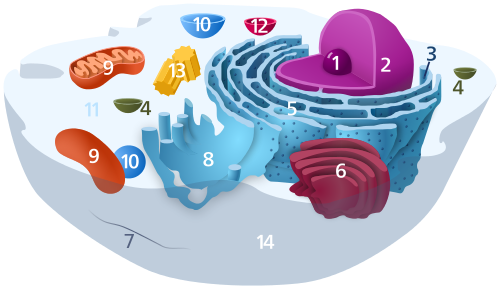
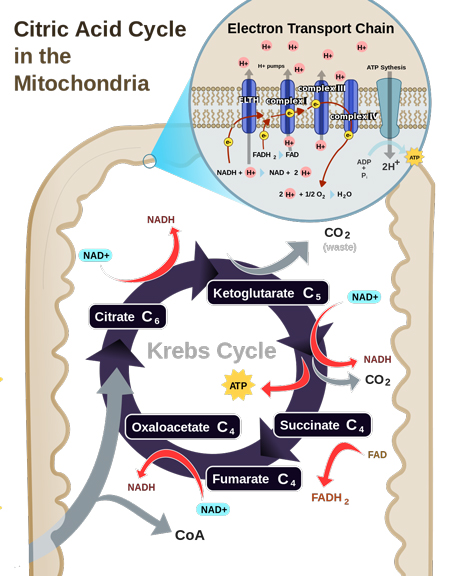
Within structures called mitochondria, microscopic power plants in the cells of eukaryotes (Effigy 3), cleaved down bits of carbohydrates, fats, and proteins all come together, feeding into a kind of reverse assembly line that goes effectually and around in a wheel. Equally the cycle goes around, the various energy-rich $.25 are incorporated at different stations. At the same time, the wheel sends other products abroad to other areas of the power plant. The pathway has many names, including the citric acrid cycle and the tricarboxylic acid cycle (TCA), because of the compounds that cycle within it. Even so, it's also known every bit the Krebs cycle, for its discoverer Sir Hans Adolf Krebs.
Cyclic associates lines
Born August 25, 1900, in Germany, Krebs earned his MD and began his research career working with Otto Heinrich Warburg. A pioneer in biochemistry, Warburg was the inventor of the manometer, an instrument that could mensurate oxygen and other gasses in blood and other fluids. Warburg was ane of the lead biochemists worldwide, and in the early on 20th century his state was the best place for emerging researchers like Krebs to become an pedagogy. Germany in this era was the global center of scientific research, especially in all areas of chemical science. So frequent were German publications in research journals that students aspiring to science worldwide would learn German language merely to be prepared to read the new articles. This was the earth in which Krebs came of age.
Krebs discovers the urea bicycle
Using the Warburg manometer, Krebs made his kickoff big discovery, the urea cycle (also called the ornithine cycle). By the belatedly 1920s, information technology was well know that the breakdown of amino acids in animals must release ammonia (NH3). Krebs new that ammonia is toxic, however somehow the body is able to convert information technology to urea, a chemical that is easily excreted in urine. Thinking associates line way, Krebs and his pupil, Kurt Henseleit, came up with a hypothetical set of reactions, showtime with the conversion of ornithine into some other chemical by receiving a piece of the amino acids containing the ammonia. The manometer immune Krebs to analyze samples of animal liver exposed to the intermediary chemicals that they suspected were made from ornithine. Krebs and Henseleit, were able to test and tweak their hypothesis, reaction past reaction. The pathway of reactions was a bike, because, afterwards a bunch of steps, ornithine was re-created. As this happened, more and more ammonia was converted to urea. Thus, as long as amino acids were continuously broken down in the liver, the urea bike would spin around and around, removing ammonia so that it did not accumulate and kill the organism. It was a milestone discovery that made Krebs world famous when he published his findings in 1932 (Figure 4).
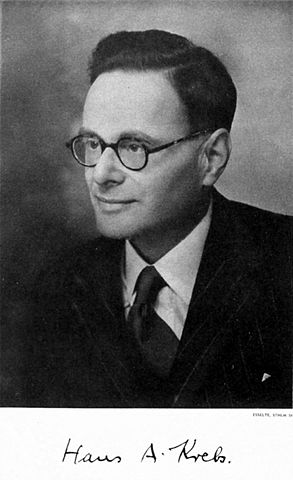
Soon after that he was fired. Similar many other academics in Frg, Krebs was dismissed from his position when the Nazis came to power in 1933, either because they were Jewish, as Krebs was, or because they opposed the Nazis. Prior to 1933, Federal republic of germany was a powerhouse in all areas of science with a plethora of Nobel prizes going to Germans. That abruptly ended with the ascent of Adolf Hitler.
Krebs relocated to England, along with many other academics escaping from Nazi controlled lands. Although he was unable to bring most of his personal possessions, he did take most of his lab equipment, including the Warburg manometer that had proven so useful in unlocking the secrets of the urea cycle.
Comprehension Checkpoint
Krebs lost his task because
The glycolysis pathway: Embden and Meyerhof
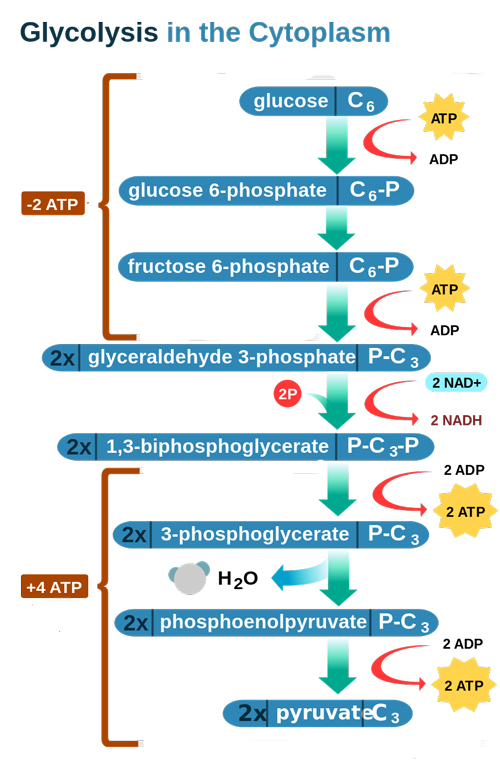
With the urea cycle backside him, Krebs wanted to focus on tracking what happened to carbohydrates in the cell. While at the University of Sheffield, Krebs ready the manometer and started working out the chemistry. I of his major goals was to map out the ultimate fate of glucose in the presence of oxygen. By this time, the initial breakdown of glucose was already understood, step-by-footstep. Known as glycolysis, this initial procedure splits each glucose molecule into 2 smaller molecules called pyruvate.
The steps of glycolysis were worked out by two biochemists, Gustav Embden and Otto Fritz Meyerhof. (A few years after Krebs, Meyerhof also fled Nazi Germany for being Jewish.) Dissimilar called-for glucose to a well-baked in the laboratory, the conversion of glucose to pyruvate in cells is carefully controlled by enzymes. Each step in the Embden-Meyerhof glycolysis pathway has its ain enzyme that performs a specialized process on ane molecule after some other, similar the factory worker at a particular workstation.
In the course of breaking down glucose into pyruvate, glycolysis provides the prison cell with some free energy, and does not require oxygen (Figure five). This is good, since many organisms live in environments where oxygen is not fifty-fifty available. In fact, today we know that the enzymes controlling glycolysis emerged extremely early in the history of life, before there was whatsoever oxygen gas in Earth's oceans or atmosphere.
The understanding of glycolysis left a big question: What happens to the pyruvate later it is produced from the breakdown of glucose? By Krebs' fourth dimension, it was known that the reply depended on whether or not oxygen was bachelor. It was also known that sure microorganisms, as well as animal muscles, produce a chemical compound called lactic acid. The reason, it turns out, is that lactic acid is very similar to pyruvate. When no oxygen is available – or in organisms that don't have the ability to use oxygen even if it is available – pyruvate is converted to lactic acid as a waste matter production. This is what happens in muscle cells during intensive exercise, particularly in an individual who has not warmed up sufficiently.
Nonetheless, as Krebs knew, something bigger must have been happening in cells when oxygen was available. Ane reason warming up helps muscles is that it brings more oxygen into the muscle cells, assuasive for conversion of pyruvate to something other than lactic acrid. Oxygen, it turns out, allows cells to activate a highly efficient organisation to interruption downwardly fuel to the ultimate terminate production: carbon dioxide (CO2).
Comprehension Checkpoint
Pyruvate is similar to
The Krebs wheel
When 19thursday century researchers burned sugar in the lab, they knew that oxygen was required to fuel the burn. This suggested that the metabolism of glucose also required oxygen, at least when glucose was cleaved down all the way to COtwo and H2O. Krebs knew that the key to understanding how about of the energy was extracted from glucose was to understand what happened to pyruvate when oxygen was nowadays. Clearly, it was something different than what happened in the absenteeism of oxygen. Think of a fork in the road at the point that pyruvate is created from the breakdown of glucose. Without oxygen, pyruvate is converted to lactic acid, but the presence of oxygen opens the gate to an alternate road that ends, not with lactic acid, but with COii. All that Krebs needed to do was figure out the various steps that occurred along the way. Luckily, he notwithstanding had his handy manometer, and luckily, he didn't need to start from scratch. A few reactions that Krebs was nigh to find as steps in his new cycle were known already as contained reactions from enquiry of an older biochemist, Albert Szent-Györgyi. It was Krebs who postulated that the reactions might be continued in a cycle, merely similar the reactions of the urea wheel that he'd discovered back in Germany.
Krebs' inquiry method was to permit slices of beef liver soak in solutions of various chemicals. Using the Warburg manometer, Krebs could then see how the unidentified liver enzymes would change the different chemicals in the solutions. Testing the reactions one past i, he discovered that the breakdown of carbohydrates, lipids, and proteins did indeed proceed in a cyclic mode. Bigger and more complex than the urea bicycle, this bicycle turned out to be the central route of all metabolic action in the cell. Krebs identified the wheel's reactions past 1937, although he tweaked it over the form of the following decade. Role of that tweaking led him to discover still i more cycle, a little one chosen the glyoxylate wheel that acted as a bypass route for a section of the Krebs cycle.
Comprehension Checkpoint
Krebs is famous for discovering
Moving molecules from workstation to workstation
Thinking about the Krebs cycle in terms of workstations is a way to recollect broadly what types of chemical compounds enter the cycle at certain points, what they are inverse into as a result of entering the cycle, and what compounds then go out the bicycle at dissimilar points. Since it is a circular pathway, at that place is no beginning or finish. For the sake of learning the Krebs cycle, nonetheless, the "first" reaction – is the conversion of oxaloacetate into citrate. While there are several differences between oxaloacetate and citrate, the most of import difference is that citrate is the bigger molecule. Its "backbone" is built of six carbon atoms, while oxaloacetate has only four. What is the source of the 2 actress carbon atoms? The chemical equations that Krebs wrote out told him that the source of the ii carbon atoms could be acetate, which had to come up from outside the cycle. Mixing oxaloacetate with his liver specimens, Krebs could test his hypothesis. Using the Warburg manometer to measure changes in oxygen and COtwo in his mixture, Krebs could tell when the cycle was turning around. The liver specimens supplied the enzymes that controlled the reactions, including the enzyme that adds ii carbons to oxaloacetate, forming citrate. This meant that Krebs could add different carbon sources, one by one, to the mixture, and see which, if any allowed the cycle to go around. Doing this, he confirmed that acetate was the needed substrate. In a test tube, as in the cells of his liver specimens, acetate had to be supplied from outside the cycle. Otherwise, the cycle would come up to a halt.
The discovery that acetate joined a wheel of reactions that led to the extraction of energy from food was a major insight, considering both sugars and fats – the major sources of dietary free energy for all organisms – can be cleaved downward to acetate, equally tin some amino acids. Krebs realized that pyruvate, the product of the initial breakdown of glucose, is very similar to acetate, except that pyruvate has one boosted carbon. If the extra carbon from pyruvate were removed, the remaining molecule was easily converted to acetate.
Comprehension Checkpoint
Most of our free energy comes from the _____ in our diet.
The acetate molecule itself is modest, and highly diffusible, so it must exist chaperoned around the jail cell by a much larger carrier molecule, called co-enzyme A (Co-A). Once the ii-carbon acetate is linked up with the four-carbon oxaloacetate, even so, the Co-A is free to pick upward another acetate and repeat the process. Meanwhile, the prison cell has a new molecule of citrate with its six carbon atoms.
Realizing that he was dealing with a cyclic pathway, Krebs discovered that citrate does non remain for very long. After its shape is changed around, it is cut down to a five-carbon molecule and then again to a four-carbon molecule, which then is modified several times until oxaloacetate is produced, all ready to be combined with a new acetate to produce more citrate, and the bike goes effectually another time. It'due south a true cycle, because the production of the cycle – oxaloacetate – is also the start ingredient for the next bike. (See Figure 6.)
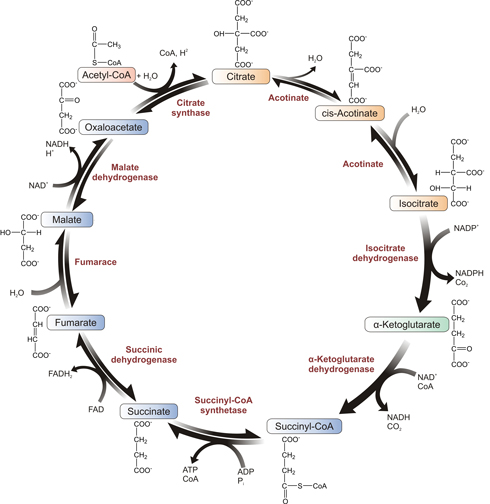
Where do the carbon atoms go when they go cut off as the wheel goes from six to v and back to four-carbon units? The cycle occurs only in aerobic organisms, life forms that use oxygen, and using the Warburg manometer Krebs discovered that a portion of the carbon removed from the principal chemical compound was combining with oxygen atoms to generate COtwo.
Comprehension Checkpoint
The Krebs cycle occurs in
ATP, the cellular free energy currency
The energy contained in fatty acids, glucose, and amino acids is held in the diverse chemic bonds that go along the private atoms together. The most common way that nosotros store the energy harvested from those chemical bonds is within a molecule chosen ATP. ATP is often chosen the cellular currency of energy. Just like economic currency, such as a dollar pecker, the free energy currency of ATP can be used to "purchase" whatever reactions or activities the cell needs to perform. Energy metabolism likewise depends on a chemical compound chosen GTP, which is nearly the same as ATP. Continuing with the dollar bill analogy, one can imagine GTP as a silver dollar coin. It's not encountered as often every bit the normal paper dollar, merely information technology has the same value and the two can exist exchanged hands. As biological fuel such equally glucose is broken down, ATP and GTP molecules are produced at different points in the assembly line.
Krebs found that the breakdown of sugars and fats into CO2, through a bicycle of many chemical reactions, produced ATP and GTP that the cell could utilise to drive all sorts of reactions and activities. However, something was clearly missing. For ane thing, the corporeality of ATP and GTP was much smaller than he predicted. Scientists knew how many calories sugars and fats provided and near of that energy was still unaccounted for in the reactions that Krebs discovered. Secondly, oxygen was not directly required for any of the reactions that Krebs discovered. Why was oxygen so important for harvesting the energy of sugars and fats if information technology wasn't required in their breakdown?
Two new free energy carriers
Looking more closely at chemic bonds of food molecules, the energy that is kickoff present in those bonds is actually carried by the electrons that course the covalent bonds. Each bond is made by a pair of electrons, and depending on how the various atoms are bundled, the electron pairs tin can hold different amounts of energy. In the course of chemic reactions that harvest the energy from the food molecules to form ATP and GTP, the energy-holding electron pairs are physically transferred from one chemic compound to another, and various compounds that carry the electrons around are called electron carriers.
During the course of the Krebs cycle, two compounds are produced that do not feed back into the cycle. They are not ATP or GTP, and their function was not obvious to Krebs. These compounds were NADH and FADHii, made from their precursors NAD+ and FADH+, every bit shown in Figure 7 (larn more almost these compounds in our Energy Metabolism Two module). Krebs knew that NADH was also made in glycolysis, and then he suspected that finding out what they do would probably reply the question of where the balance of the ATP in cellular respiration comes from.
The discovery of the Krebs wheel would earn Hans Adolf Krebs the Nobel Prize in Physiology and Medicine in 1953, and five years after a knighthood. Even though Krebs did not discover the adjacent phase of cellular respiration – oxidative phosphorylation - his piece of work with the urea wheel and the Krebs cycle probably helped to inspire those discoveries, because, as it turned out, oxidative phosphorylation was besides a kind of assembly line.
Summary
Food fuels our bodies, simply how does our body convert food molecules into usable free energy? This module looks at glycolysis and the Krebs wheel, two important stages of cellular respiration, the process past which cells harvest energy from food. Information technology highlights the work of Sir Hans Adolf Krebs and his focus on cyclic pathways as he discovered the primary biochemical pathway for breaking down fuel to produce free energy.
Central Concepts
-
In a cell, chemical compounds are put together, taken autonomously, and moved around through pathways that resemble moving assembly lines.
-
The chief types of biological macromolecules that cells employ for fuel are sugars, fats, and proteins.
-
The main biochemical pathway where the breakdown of biological fuels comes together is called the Krebs cycle. Named for its discoverer, Sir Hans Adolf Krebs, this pathway is like a circular associates line.
Source: https://www.visionlearning.com/en/library/Biology/2/Energy-Metabolism-I/215
0 Response to "what metabolic occured in the test tuves to produce this gas?"
Post a Comment