Thai start-up on a mission to revive old clothes and slow down fashion industry
BANGKOK: Hau Thi Pa was heavily meaning with her first child. Still, she insisted on joining a workshop in Bangkok with other Hmong refugees from Vietnam earlier this year.
A few of them were mothers with young babies. Their tiny faces popped out from sling bags on their mothers' backs, all hand-sewn and decorated in the ethnic Hmong style.
"I want to exist able to earn income by myself," Hau Thi Pa told CNA.
The 20-year-quondam arrived in Thailand with her family unit at a very young age. She is skilled at sewing, which is a Hmong traditional art form passed downwards from mothers to daughters for generations.
Similar other participants, Hau Thi Pa was learning the fine art of redesigning old clothes for customers in the workshop organised by Reviv - a Bangkok-based online first-upwards that offers clothing repair and alteration services.
Besides giving old apparel a new life, information technology too promotes a style civilisation that cares more than about the environment and the vulnerable in society.
"People are increasingly talking most issues of the fashion industry, which consumes a lot of resource - whether it would be trees, land, water or free energy. It likewise generates waste, not to mention labour issues," said Reviv co-founder Poom Kometsopha.
"In fact, we've already had enough clothes for everyone in this world. The problem is a lot of them were merely discarded."
Reviv was launched in early on September with a master goal of educating consumers about the environmental and social impacts of the fashion industry. It offers online services to make habiliment repair and amending easier and more convenient.
Although such services are not uncommon in Thailand, it is not always like shooting fish in a barrel to find the providers nowadays. Many of them are scattered outside the city center and practice not have a fixed working schedule.
Moreover, many Thai consumers have adopted a negative attitude towards one-time clothes, co-ordinate to Poom.
"Repairing or reusing one-time wearing apparel may not be so fancy or well accustomed," he said.
"The culture of fast style has taught usa to associate our self-worth or value with ownership new apparel all the time. Then, opting for erstwhile wearing apparel doesn't quite boost people'south self-esteem."

By connecting consumers with quality artisans online, his first-upwardly hopes to change such perception and advocate a more sustainable kind of style in the state.
Its services are available on the web and the Line messaging app. Customers can cull from the menu how they want their clothes repaired or changed - from patching to size aligning and embroidery.
Once payment is made, customers can post their clothes to the visitor. They tin can also track the work progress online and go their clothes dorsum inside two to iii weeks.
FAST FASHION Damages Environment
Despite its main service in clothing repair, Reviv was in fact created with a green mission to fight fast fashion in Thailand, where garments are affordable and easily discarded.
Fast manner refers to the mass production of inexpensive, trendy garments that are low-quality and disposable. The business model is common in Thailand and frequently employs depression-paid workers.

Data from international market place enquiry and analytics firm YouGov showed 4 in 10 Thai adults take thrown away an item of habiliment after wearing it just once.
In Oct 2017, it conducted research with 1,137 respondents in Thailand and found that one in five millennials - those anile between 25 and 40 now - keep their wearing apparel for under a yr before throwing them away.
"The most pop reason for disposing of clothes is considering they no longer fit, which 45 per cent consider grounds for throwing garments away," YouGov reported.
Other common reasons are because their clothes accept been damaged. The inquiry also showed millennials are more likely to dispose of their garments because they are "bored" of wearing them, compared to the older generation.
"Beyond all generations, nearly one in v (17 per cent) accept thrown unwanted dress in the bin," YouGov added.
Each year, various practices in the fashion manufacture have devastating impacts on the environment. According to the United nations Environment Programme, the industry produces between 2 per cent to viii per cent of global carbon emissions and releases half a million tonnes of synthetic microfibres into the ocean annually.
Every 2d, the UN said, the equivalent of one garbage truck of textiles is landfilled or burned and if zip changes, "by 2050 the manner industry volition use upwards a quarter of the earth'southward carbon upkeep".
Although more than retailers are moving towards sustainable way that is friendlier to the surroundings, their transformation does not address the overconsumption in the style industry.
"If consumers go along to consume besides much and forget well-nigh their sometime clothes, the problems of this industry will never end, no thing how many mode brands are environmentally friendly," Poom said.
"FELT LIKE I GOT A NEW PAIR OF JEANS"
Past making wear repair like shooting fish in a barrel and more accessible, Reviv'due south co-founders hope more than people would reuse their clothes instead of ownership new ones while saving the planet from more carbon footprints, waste and plastic.
They besides offering various styles of needlework to help clients customise a new look for their quondam garments, giving them a new life that is not simply fashionable but also tailored to what each person needs.
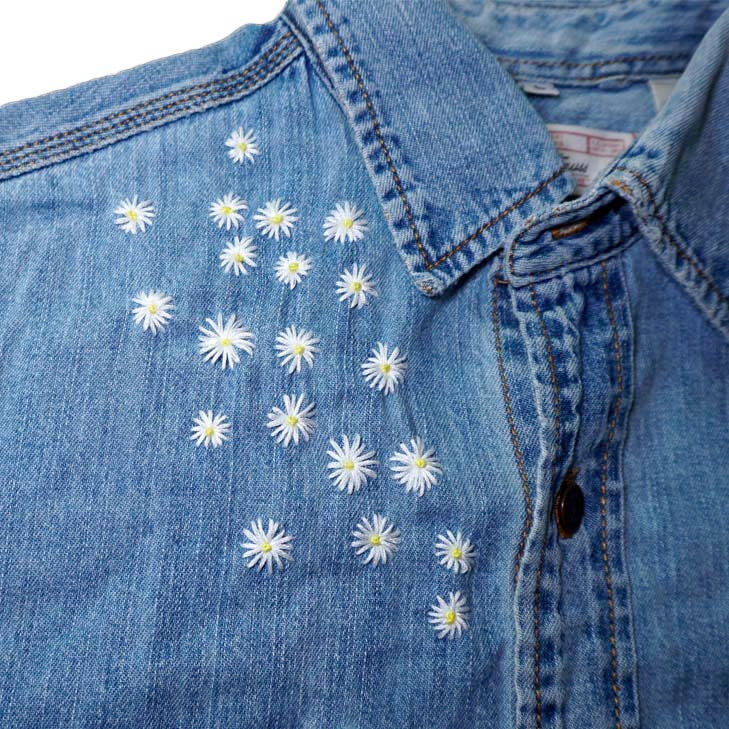
One of its customers is Jirapa Chonweerawong. She has a pair of jeans that have been with her for more than 20 years. Well-worn and damaged, they were left in the closet for a long fourth dimension until Jirapa came across the kickoff-up and sent them in for repair.
"When I got them back, I wasn't and so excited. Merely when I put them on, I felt like I had got a new pair of jeans. Nowadays, when I need to become somewhere, I'd catch them first with no hesitation," she told CNA.
"I similar that there are patterns and we can choose them ourselves. The needlework is corking."
Besides a new expect for her former jeans, Jirapa also enjoyed the fact that one more garment was saved from the landfill. Her purchase also went towards helping ethnic minorities such as Hau Thi Pa equally well equally other vulnerable groups in club.
Through its choices of raw materials, business partners and artisans, Reviv hopes to remind its customers of diverse social issues, from the statelessness of refugees to a lack of social security among non-registered garment labour.
It also works with suppliers who have special needs and visually impaired craftsmen who create textiles and embroidered fabrics for its customers.
"Customers can use their piece of work to repair or redesign their clothes. By doing so, they give voice to these voiceless people," Poom told CNA.
"They do it past wearing their stories, showing and telling them to others."
For Hau Thi Pa, who currently heads the sewing squad, the chore has enabled her to utilize her sewing skills to support her family.
Each time she works, the young mother also gets to relieve a piece of clothing from landfill.
"I want my customers to be happy with the clothes they even so want to proceed wearing," she said.
0 Response to "Thai start-up on a mission to revive old clothes and slow down fashion industry"
Post a Comment